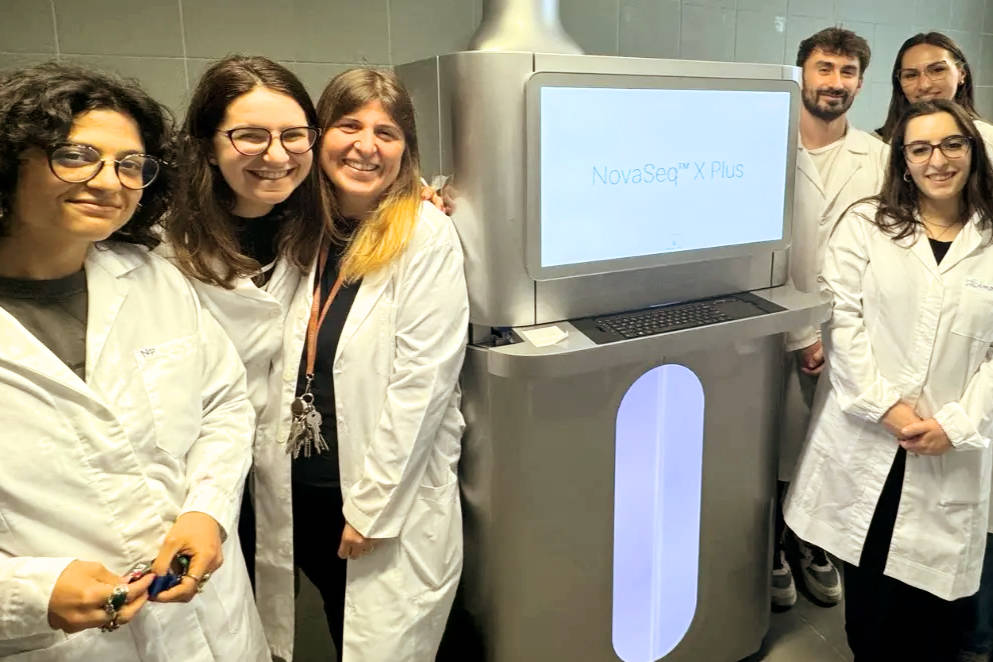
The NovaSeq X Plus, a cutting-edge DNA sequencer, boosts ELIXIR-IT's research capacity, allowing over 100 human genome sequences in 48 hours, solidifying our leadership in genomics and bioinformatics.
ELIXIR-STEERS, a new EU-funded project, will enhance federated data analysis in life sciences across Europe. The project focuses on improving software and workflows to increase efficiency, reduce duplication, and lower the carbon footprint of computational research.
The EU's "Genome Data Infrastructure" (GDI) project will create a system for sharing genomic and clinical data for precision medicine, with Italy participating.
ELIXIRxNextGenIT will expand Italy's 'Omics and Bioinformatics' infrastructure. It aims to enhance ELIXIR-IT's services, including creating a Federated European Genome-phenome Archive.
Ab initio detection of multiple epitranscriptomic modifications from ONT direct RNA sequencing data
Non-canonical nucleotides are widespread chemical modifications in eukaryotic genomes and transcriptomes, especially within the epitranscriptome. Traditional enrichment-based sequencing methods cannot detect them at single-molecule resolution, a limitation overcome by nanopore sequencing.
Researchers from the University of Bari (Italy) present a transformer-based model for the ab initio detection of multiple RNA modifications, along with two tools, NanoListener and NanoSpeech, to create training datasets and develop modification-aware basecallers. Their approach enables the simultaneous identification of up to nine ribonucleotide variants.
Embedding-Based Alignments Capture Structural and Sequence Domains of Distantly Related Multifunctional Human Proteins
Protein embeddings encode sequence information using protein language models. The Embedding-Based Alignment (EBA) method enables pairwise embedding comparison and remote homolog detection. In this paper we show that, when applied to a set of multifunctional human proteins, EBA identifies remote homologs sharing structural and functional features, validated on the Swiss-Prot database.
CREDO: a friendly Customizable, REproducible, DOcker file generator for bioinformatics applications
CREDO, a Customizable, REproducible, DOcker file generator for bioinformatics applications, has been developed as a tool to moderate reproducibility issues by building and distributing docker containers with embedded bioinformatics tools. CREDO simplifies the process of generating Docker images, facilitating reproducibility and efficient research in bioinformatics.
An automated pipeline integrating AlphaFold 2 and MODELLER for protein structure prediction
In this work, it is evaluated the possibility of improving AlphaFold2’s three-dimensional predictions by developing a new pipeline (AlphaMod) that integrates AlphaFold2 with MODELLER, a traditional homology modeling program. For this study, MARCONI100 at HPC@CINECA was used, which was made available through an ELIXIR project.